DQ/IQ/OQ/PQ In‑Depth Analysis:
GMP Qualification Practices for Filling Machines, Packaging Machines & Automated Production Lines
When it comes to equipment qualification in pharmaceutical and health‑product industries, four abbreviations — DQ, IQ, OQ and PQ — are well‑known across the sector. Many projects produce four separate qualification protocols, four final reports and compile complete sets of records for filing. However, a common pain point appears frequently on‑site: substantial overlap between IQ and OQ test items, and duplicated testing between OQ and PQ. Even after all four reports are approved, certain functions fail to meet real‑world production requirements once the equipment goes into commercial operation.
Buyers often ask: there are numerous manufacturers supplying filling machines, packaging machines and production lines. Beyond robust build quality and a seamless end‑to‑end order journey from initial consultation through final delivery, what else sets us apart and makes our equipment the preferred choice?
The root cause is seldom “failure to perform the four Qs”. Instead, teams often lack clarity on what each qualification phase is intended to demonstrate. Many hardware‑only equipment suppliers overlook compliance‑related qualification capabilities, which are frequently under‑evaluated during procurement yet decisive to project success.
Per Annex 11 of EU‑GMP and Chinese GMP for Qualification and Validation, DQ, IQ, OQ and PQ belong to equipment qualification activities. Each phase answers a distinct core question:
DQ: Does the equipment design satisfy user requirements?
IQ: Does the as‑installed condition match the approved design?
OQ: Can the installed equipment perform as designed within its intended operating range?
PQ: Can the equipment deliver consistent, reliable performance under actual production conditions?
These questions may look similar, yet each captures distinct evidence dimensions. For our filling machines, standalone packaging machines and multi‑unit automated production lines, qualification for stand‑alone units and integrated lines share common principles while featuring critical differences. For production lines, besides individual‑unit qualification, additional validation covering process‑step hand‑offs, signal interaction and line‑wide interlock logic is mandatory; standalone‑machine protocols cannot be copied directly for complete lines.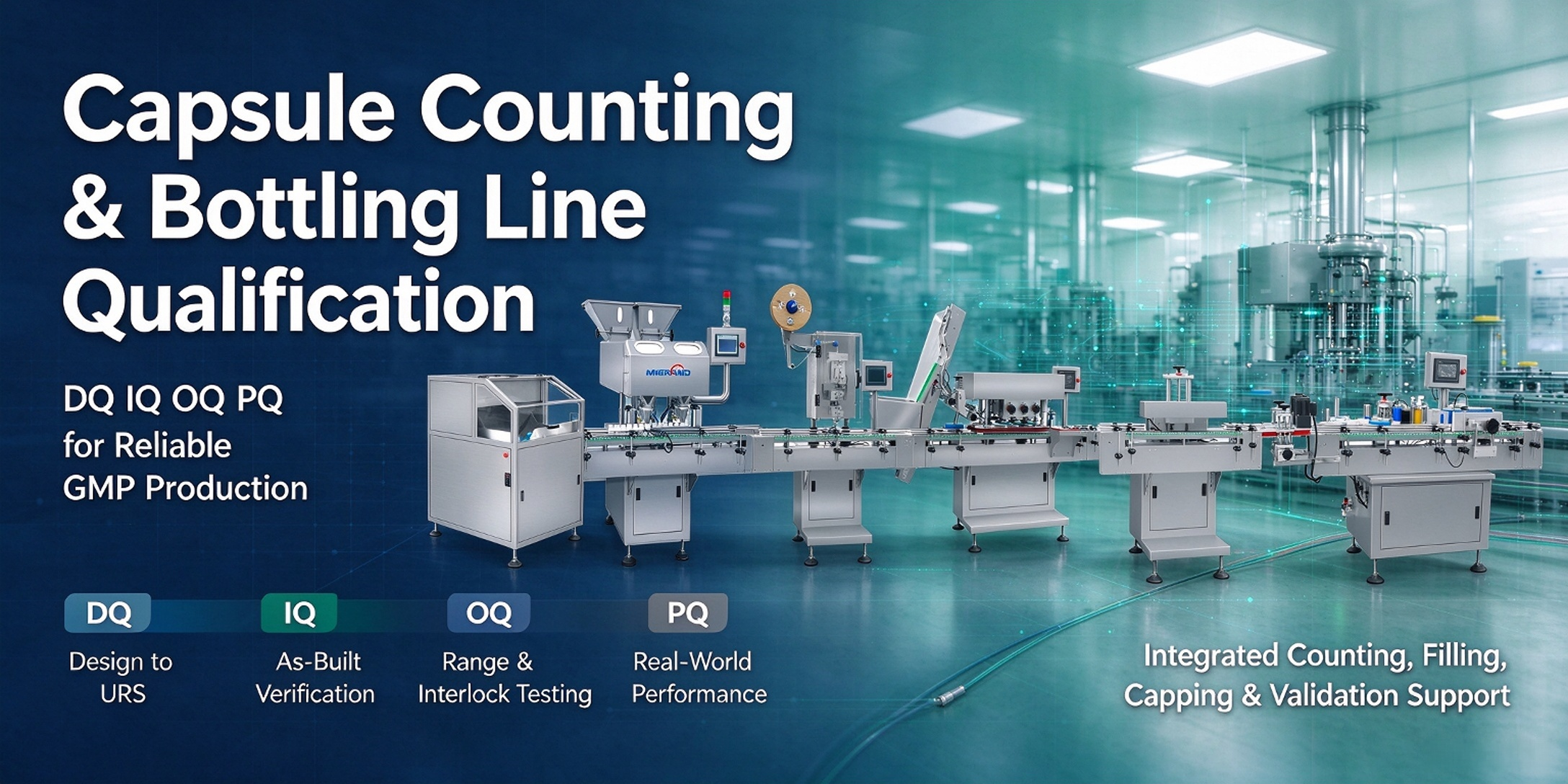
1. Design Qualification (DQ): Validate Design‑to‑URS Alignment, Not Merely Technical Sophistication
Design Qualification (DQ) demonstrates that equipment design complies with approved User Requirement Specifications (URS) and applicable GMP regulations for new or modified facilities and equipment.
DQ starts with the URS, not supplier brochures or equipment datasheets.Some suppliers deliver off‑the‑shelf standard machine configurations without thorough URS alignment. This leads to costly rework and schedule delays once on‑site, when equipment fails to match process and compliance expectations. At our company, our engineering team engages deeply at pre‑sales stage. Rather than rushing order closure, we help buyers decompose URS requirements, translating process parameters, throughput targets, GMP compliance, audit‑trail functionality, line‑to‑line interconnection, cleaning and maintenance needs into formal design inputs. This eliminates risks of purchasing equipment unfit for purpose at the very beginning.
A sound URS shall define: intended product for the filling / packaging machine or full production line, throughput range, material‑contact surface specifications, clean‑grade requirements, cleaning, maintenance and calibration expectations, access control & audit‑traceability, as well as integration with utilities and upstream/downstream processes.
Our DQ exercise fundamentally compares: what the user requires (URS) versus what the proposed design delivers.
Key DQ practice for our equipment
Filling machine DQ: Evaluate dosing principles (volumetric / gravimetric), filling‑valve construction, 316L wetted‑part specifications, seal material selection, viscosity compatibility, no‑bottle‑no‑fill logic and high/low‑level alarm functions.
Packaging machine DQ: Review heat‑seal assemblies, forming tooling, coding systems, on‑line rejection mechanisms and compatibility across multiple packaging formats.
Automated production‑line DQ: Apart from individual‑unit reviews, assess line layout, material flow, conveyor interface, cross‑contamination prevention, inter‑equipment signal logic and host‑system data communication.
We build a URS‑to‑design traceability matrix mapping every user requirement to its corresponding design implementation. It is critical to understand that DQ is not equivalent to signing a technical agreement. A signed technical agreement does not constitute completed design qualification unless it traces back to a formally reviewed URS. DQ must be finalized before manufacturing commences. Any URS change triggers DQ matrix revision; DQ shall never be completed retrospectively after equipment fabrication.
Many competitors treat DQ as merely contract paperwork. By embedding process and GMP compliance into mechanical drawings at DQ phase, we mitigate downstream validation risks for customers — one major reason why partners select our solutions.
2. Installation Qualification (IQ): Verify As‑Built Equipment Matches Approved Drawings
DQ validates design on paper. After manufacturing, shipment and site erection, Installation Qualification (IQ) answers: does the physical installed setup correspond to our approved design?
Per GMP Annex requirements, IQ verifies equipment, piping and utility installation against engineering drawings and technical specifications, collects supplier documentation and calibrates critical instruments. DQ reviews drawings on paper; IQ inspects the physical equipment installed on‑site.
Several competitors only perform power‑on commissioning after delivery and provide minimal documentation. They leave all validation paperwork burdens to customers, which may trigger audit non‑conformities due to missing certificates or incomplete drawings.
Key IQ practice for our filling, packaging machines & production lines
Physical verification: Confirm model numbers, serial numbers and critical component part‑numbers match the Bill‑of‑Materials; collect material certificates and sealing‑component documentation.
Mechanical & piping installation: Check machine leveling, piping routing and fluid direction against as‑built drawings. For integrated lines, verify conveyor height alignment and material flow layout to avoid cross‑contamination hazards.
Utility acceptance: Confirm power supply, compressed‑air pressure & dew‑point, cooling‑water parameters satisfy technical specifications.
Instrument calibration: Ensure gravimetric filling modules, pressure transmitters and packaging‑machine heat‑temperature probes are within valid calibration cycles.
Documentation & software archiving: Archive operation / maintenance manuals, electrical schematics; confirm on‑site PLC / HMI firmware versions match FAT‑validated revisions; verify safety guards and E‑stop interlocks are physically fitted.
IQ generates documented evidence that hardware, installation and supporting documentation comply with design intent. Any installation deviation must be recorded, assessed and closed prior to IQ approval, which is a prerequisite to starting OQ. We deliver a complete IQ‑supporting documentation package out‑of‑the‑box, including as‑built drawings, material certificates and software version records. This significantly reduces customers’ internal documentation workload and lays solid groundwork for subsequent qualification work.
3. Operational Qualification (OQ): Challenge Intended Operating Ranges — Not Just “Power‑On Tests”
Correct installation does not guarantee full functional performance. Operational Qualification (OQ) proves the installed equipment performs to design specifications across its intended operating range, including upper/lower limits and worst‑case conditions where applicable.
OQ runs without real production materials; water, dummy containers or surrogate granules serve as test media. OQ focuses purely on equipment behaviour independent of product characteristics. Guided by quality risk management, it is unnecessary to test every absolute manufacturer‑stated extreme parameter. The objective is sufficient challenge for critical functions, rather than maximising test quantity.
Many suppliers only run machines at nominal speed during Factory Acceptance Test (FAT). Alarms and interlock defects are only uncovered during customer‑site OQ, causing costly project delays. In our FAT workshops, we simulate site‑like conditions, perform boundary‑limit testing and simulate fault scenarios to resolve nearly all functional defects before shipment. This prevents costly rework at the customer facility.
Key OQ practice for our equipment
Filling machine OQ: Test minimum, nominal and maximum throughput ranges; assess gravimetric / volumetric repeatability under dummy‑run conditions; validate no‑bottle‑no‑fill, tank‑level alarms, no‑container stop and overload protection; simulate fault conditions to confirm alarm and interlock responses; verify password protection for critical‑parameter modification.
Packaging machine OQ: Full‑range speed testing; heat‑seal temperature‑control accuracy; simulate defective units to validate automatic rejection performance; coding‑print interlock; safety‑door‑open and emergency‑stop shutdown logic.
Automated production‑line OQ (line‑specific scope): Full‑line start‑stop sequence; fault‑propagation interlocks between upstream and downstream units; simulate bottle jams, material shortage and missing packaging components to verify line‑wide protection; validate counter readings and alarm‑data exchange with host systems.
OQ answers whether all functions work reliably within the intended operating window. After all deviations are assessed and closed, OQ report approval confirms hardware and software functionality, enabling progression to PQ. More than supplying physical machines, we bring on‑site‑risk mitigation forward to factory testing — a highly‑valued differentiator for our clients.
4. Performance Qualification (PQ): Demonstrate Stable Output Under Real‑World Operating Conditions
Successful OQ with surrogate media does not guarantee stable behaviour under actual manufacturing circumstances. Performance Qualification (PQ) demonstrates that installed equipment runs reliably and consistently when operated per approved production methods under real‑use conditions.
A widespread misconception: PQ does not mandatorily require three consecutive batches with actual product. GMP Annex explicitly permits production materials, suitable substitutes or simulated articles for PQ execution. The well‑known “three consecutive successful batches” requirement belongs to process validation, not equipment PQ. The number of PQ test runs shall be determined through quality risk management.
Key PQ practice for our equipment
PQ shall be executed on‑site within the production environment by regular operating personnel following formal SOPs, using real product or qualified surrogate materials.
Filling machine PQ: Evaluate fill‑volume / fill‑weight accuracy and repeatability; long‑run stability against splashing or leakage; jam‑frequency statistics and process capability (Cpk) assessment for critical metrics.
Packaging machine PQ: Seal integrity & heat‑seal strength, finished‑product pass rate; real‑condition rejection effectiveness; coding‑print legibility and correctness.
Automated production‑line PQ: Continuous full‑line operation to assess inter‑station transfer stability; overall line yield; performance during format‑change‑over and normal start‑stop cycles; complete logging of faults and corrective actions.
PQ answers one central question: can the equipment deliver consistent expected performance under real production conditions? Our technical specialists can support customers on‑site through PQ campaigns, help identify latent operational risks and support SOP optimisation. We do not merely sell machinery — we accompany customers through the full qualification‑to‑commissioning lifecycle.
5. Clarify Boundaries: Distinguish PQ from Process Validation
A frequent project question: if PQ already covers real‑condition trials, why conduct separate process validation? The two have distinct scopes:
PQ: Focuses on equipment / system performance; verifies that filling machines, packaging machines or complete production lines deliver reliable hardware‑level performance under practical conditions.
Process Validation: Focuses on the complete manufacturing process. It proves that the whole workflow (materials, operators, procedures, equipment and process parameters combined) consistently yields finished products complying with registration specifications.
PQ validates equipment capability; process validation validates the full manufacturing workflow. Regulations allow PQ to be combined with OQ or process validation where justified. This clarifies that regulations do not rigidly mandate four fully independent sets of qualification documents for every project.
Many customers’ teams have limited qualification experience and struggle to separate equipment qualification from process validation, resulting in redundant testing and wasted manpower. Our experts provide professional guidance to rationalise test scope and save customers’ time and labour costs.
6. Demystify Misconceptions: Four Qs Are Logical Requirements, Not Rigid Document‑Splitting Rules
Some internal company policies require separate protocols and reports for DQ / IQ / OQ / PQ. While acceptable for internal governance, this internal practice should not be misinterpreted as a regulatory mandate to split every project into four fully independent activities.
The overarching GMP Annex principle: the scope and depth of qualification shall be determined via risk‑based thinking. PQ may be combined with OQ or process validation where justified.
DQ‑IQ‑OQ‑PQ represent four logical propositions to be proven. Documents may be consolidated and certain test activities combined. Consolidation must never result in any required proof objective being omitted.
7. Sequential Logic: Phases Shall Proceed in Order, With Risk‑Based Conditional Approval Permitted
Even with possible activity consolidation, there is a clear sequential workflow:
URS → DQ → IQ → OQ → PQ → Continued Qualification Status
Regulations state that subsequent phases shall normally commence only after the preceding‑phase report is approved. Nevertheless, risk‑based conditional approval is allowed: if unresolved deviations from an earlier phase are assessed to exert no critical impact on follow‑on work, conditional approval can grant progression while corrective actions continue. It is not an absolute rule that any open deviation blocks all further work — risk assessment governs the decision.
For filling‑machine and production‑line projects: minor cosmetic non‑conformities identified in IQ with no impact on product quality or equipment function may receive conditional IQ approval to proceed to OQ while rectification proceeds. Critical deviations such as non‑compliant wetted‑part material must be fully closed before advancing.
Our team possesses in‑depth familiarity with international and local GMP qualification rules. When deviations occur during projects, we support customers with risk‑assessment reasoning to balance project timeline and compliance obligations.
8. How to Evaluate DQ/IQ/OQ/PQ Protocol Quality: Focus on Core Questions Per Phase
Protocol quality is not measured by page count. Each phase shall answer its targeted core question:
DQ: What evidence proves this filling‑machine / packaging‑machine / production‑line design satisfies the approved URS?
IQ: What objective evidence confirms the as‑installed equipment matches the approved design?
OQ: What test evidence demonstrates reliable performance within the intended operating range?
PQ: What data demonstrates consistent expected performance under real‑world production conditions?
Duplicated test items across four documents typically signal poorly‑demarcated qualification logic. Conversely, consolidated reports remain valid provided all four core questions are answered with traceable evidence.
Buyers often focus on price and hardware specifications during tendering, underestimating suppliers’ GMP‑qualification expertise. For identical‑looking filling machines, the supplier’s grasp of qualification logic directly influences validation lead‑time and audit risk — another decisive factor for our customers’ purchasing decisions.
9. Qualification Does Not End With PQ Approval: Full‑Lifecycle Management
Completion and approval of DQ‑IQ‑OQ‑PQ reports does not mark the end of qualification activities. Major equipment modification, critical‑component replacement, control‑system firmware upgrade or equipment relocation triggers change‑control procedures. Risk assessment determines whether partial IQ/OQ or full re‑qualification shall be performed. Periodic performance reviews maintain ongoing qualification status; protocols, raw test records and deviation reports shall be retained for audit readiness.
Many equipment suppliers cease support after delivery. They provide no qualification‑related assistance when later modifications or upgrades happen. In contrast, we offer full‑lifecycle technical backing. For retrofits, component swap‑outs and software revisions, we supply necessary qualification‑input documentation to continuously safeguard customers’ compliance posture.
10. Our Qualification‑Related Support for Customers’ Projects
For our self‑manufactured filling machines, packaging machines and integrated automated production lines, we deliver comprehensive qualification support:
During DQ phase: Supply drawings and material certificates; support URS‑to‑DQ traceability matrix and FMEA risk‑analysis inputs.
FAT: Conduct factory‑floor simulation testing to uncover functional defects prior to shipment and reduce on‑site commissioning risks.
SAT (Site Acceptance Test) execution support.
Deliver qualification‑reference documentation packages; assist protocol drafting, on‑site test guidance and operator training for IQ/OQ/PQ.
Provide qualification‑related technical support for future modification and retrofitting projects.
Conclusion
The true challenge of DQ, IQ, OQ and PQ lies far beyond memorising four abbreviations. The core principle remains: be clear what each qualification phase intends to prove. DQ proves design aligns with user requirements; IQ proves installation follows approved design; OQ proves reliable operation within intended ranges; PQ proves stable performance under real‑production conditions.
What these four‑Q activities build is not merely four thick binders of documents, but a complete evidence chain: whether requirements translate into correct design; whether design is correctly implemented on‑site; whether installed equipment delivers intended functions; and whether consistent performance is achieved in real manufacturing.
For automated integrated production lines, special attention must be paid to line‑wide interlock and process‑transfer qualification beyond individual‑unit testing. Risk‑based thinking shall define qualification scope, mitigate compliance risks and secure consistent product quality.
Customers choose our solutions not only for well‑built filling and packaging equipment and a smooth order‑to‑delivery experience. They select a complete compliance‑oriented solution covering requirement clarification, GMP‑embedded design, pre‑shipment FAT challenge‑testing, turn‑key qualification documentation, on‑site test support and full‑lifecycle modification services. By integrating GMP‑qualification logic across the whole equipment lifecycle, we help customers shorten project timelines, lower validation workload and minimise audit‑related risks — delivering equipment that works reliably, projects that deploy smoothly, and audit‑ready manufacturing systems.

 English