Box‑Style Selection for Automatic Cartoning Lines: An In‑Depth Comparative Analysis of Self‑Lock Bottom Cartons vs. Tuck‑in Bottom Cartons
1. Introduction: Carton Style Selection Impacts More Than Just Packaging
When planning an automatic cartoning production line, carton structural selection is a high‑impact decision with cascading effects. It not only determines packaging appearance and material cost, but also profoundly influences cartoner machine complexity, production stability, equipment safety, as well as overall line efficiency and labor expenditure.
The self‑lock bottom carton and tuck‑in bottom carton are two of the most widely‑adopted carton constructions, yet they deliver vastly different performance under automated production conditions. This paper analyzes their differences starting from structural principles, and further compares their adaptability to cartoning machinery, to provide selection references for production‑line engineers and planners.
2. Fundamental Differences in Structural Principles
2.1 Self‑Lock Bottom Carton
Through die‑cutting and creasing, the self‑lock bottom carton is formed with interlocking tabs and locking cutouts on its base. When the blank carton is expanded, the tabs engage with locking cutouts to achieve mechanical self‑locking with a “pop‑up‑and‑lock‑in‑place” effect. No glue or adhesive tape is required for this joint.
This construction delivers outstanding forming efficiency for manual packing operations. However, it mandates sufficiently high paperboard stiffness and extremely precise die‑cutting quality.
2.2 Tuck‑in Bottom Carton
The base of a tuck‑in bottom carton consists of four base flaps (front, rear, left and right), which are folded and interlocked to bear load‑bearing weight. Instead of precision‑machined interlocking geometry, the bottom is secured by friction and mechanical interengagement between flaps.
Its simple structure brings higher tolerance to paperboard variations and die‑cutting imperfections, and delivers superior load‑bearing capacity.
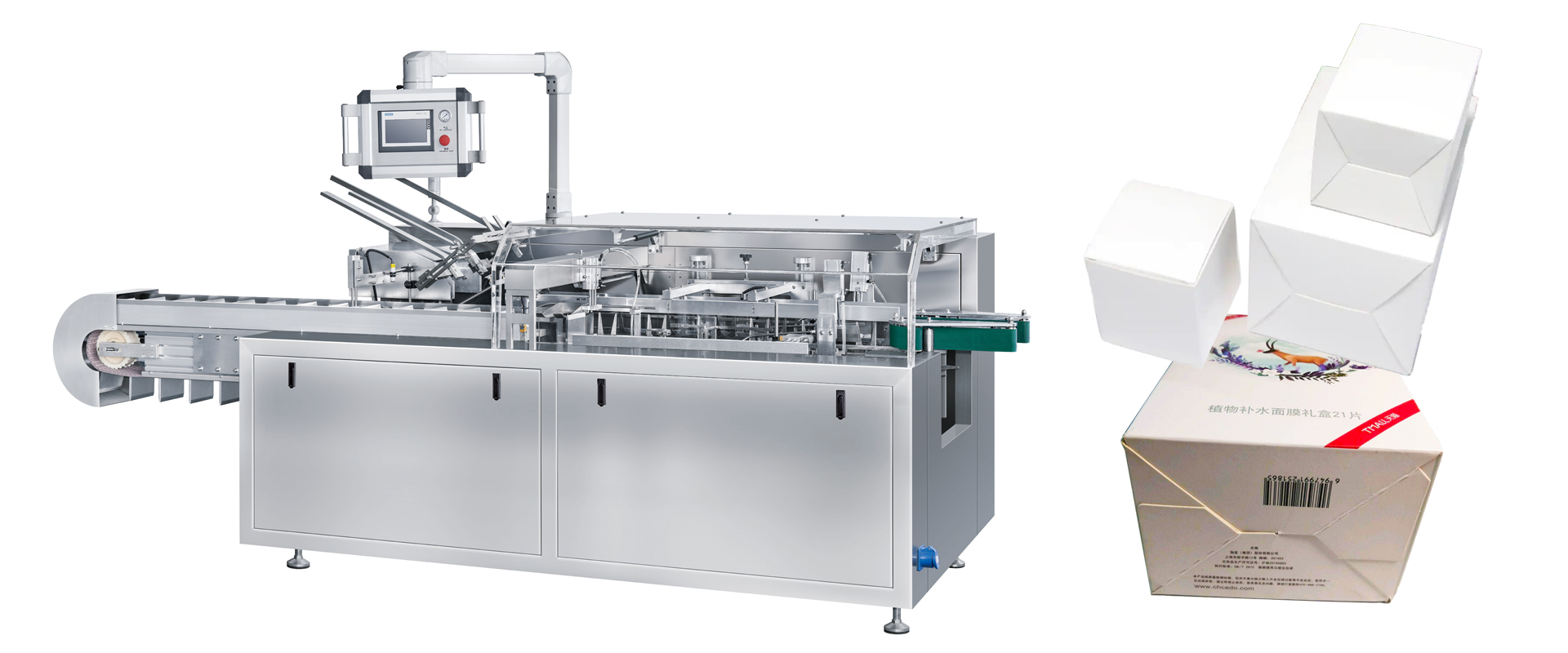
3. Cartoner Machine Compatibility: Six‑Dimension In‑Depth Comparison
3.1 Equipment Mechanical Complexity
This is the sole advantage of self‑lock bottom cartons on the machinery side.
• Self‑lock bottom carton: Carton opening and bottom forming occur simultaneously. As suction cups pull the carton blank from the magazine, bottom tabs and locking cutouts engage automatically. No dedicated bottom‑folding mechanism is required on the cartoner, resulting in a relatively streamlined machine configuration.
• Tuck‑in bottom carton: After the carton blank is pulled open, its four base flaps remain laid flat. Dedicated bottom‑folding guides and tuck‑in blades must be installed along the conveying path to sequentially fold and interlock each flap. This increases machine complexity. Nevertheless, modern cartoner manufacturers have mature designs for tuck‑in bottom forming assemblies.
Conclusion: Self‑lock bottom cartons hold an advantage in machine mechanics by eliminating a dedicated bottom‑folding subsystem. |
3.2 Magazine Capacity and Carton‑Feeding Labor Workload
This marks the first major shortcoming of self‑lock bottom cartons for automated production.
• Self‑lock bottom carton: Pre‑creased overlapping interlocking base geometry creates higher stack thickness for individual blanks. Stacked blanks tend to form uneven wedge‑shaped piles. With identical magazine length on the cartoner, fewer cartons can be stored. Operators must perform frequent carton refilling, increasing manual workload and disrupting continuous automated production.
• Tuck‑in bottom carton: Base flaps lie flat in the blank state. Individual blanks are thin and uniform, stacking neatly and evenly. The same magazine volume accommodates far more carton blanks, supporting extended unattended operation with minimal refilling frequency.
Conclusion: Tuck‑in bottom cartons outperform significantly in magazine capacity and manual feeding workload. |
3.3 Carton Opening & Forming Reliability
This is the key performance dividing line between the two carton styles in production environments.
• Self‑lock bottom carton: Successful opening is highly dependent on paperboard stiffness and die‑cutting accuracy. Batch‑to‑batch paperboard variations or minor creasing deviations from carton suppliers may prevent proper tab engagement, leading to half‑opened cartons jamming at processing stations. Such jamming is not a rare occurrence and is nearly inevitable during high‑volume production runs.
• Tuck‑in bottom carton: Flap folding and interlocking mechanics are robust and forgiving. The design tolerates wide variation in paperboard quality and die‑cutting inaccuracies. Even slight angular deviations during flap folding can be corrected mechanically by guiding rails, resulting in very low opening‑failure rates.
Conclusion: Tuck‑in bottom cartons deliver decisive advantages in production stability. |
3.4 Machine Safety and Fault Tolerance (Most Critical Risk Factor)
This represents the most severe drawback of self‑lock bottom cartons in automated lines, and the primary reason many manufacturing plants abandon this construction.
• Self‑lock bottom carton: Carton jams bring consequences beyond simple production downtime. The cartoner pusher follows fixed cyclic timing and will not halt automatically upon jamming. If a carton fails to fully erect, its internal cavity remains undersized. When the pusher forces the product into position, the product collides against the incompletely‑formed carton or machine components. Minor failures result in bent pushers and damaged products; severe incidents can damage core transmission components including cams and gears, causing extended downtime and high repair costs. This constitutes a low‑probability, high‑consequence hazard.
• Tuck‑in bottom carton: Even when flaps are inadequately folded, forced product insertion will not create rigid mechanical impact. In most cases, the product simply fails to enter the carton. Machine sensors detect the anomaly and trigger an alarm‑initiated stop, with no damage to mechanical assemblies. The design delivers inherent mistake‑proofing characteristics.
Conclusion: Tuck‑in bottom cartons possess intrinsic advantages in machine safety; self‑lock bottom cartons carry tangible collision‑damage risks. |
3.5 Carton Procurement & Material Cost
• Self‑lock bottom carton: Complex geometry requires high‑precision die‑cutting and mandates paperboard with adequate stiffness, leading to higher per‑unit carton cost. To guarantee opening performance, manufacturers are limited to a narrow pool of high‑grade board suppliers, reducing procurement flexibility.
• Tuck‑in bottom carton: Simple construction simplifies die‑cutting with relaxed paperboard specifications, yielding lower per‑unit cost and a broad selection of qualified suppliers.
Conclusion: Tuck‑in bottom cartons excel in material cost and supply‑chain flexibility. |
3.6 Comprehensive Maintenance & Operational Costs
Cost Item | Self‑Lock Bottom Carton | Tuck‑in Bottom Carton |
Carton procurement cost | High | Low |
Initial machine investment (mechanical complexity) | Slightly lower (no bottom‑fold mechanism) | Slightly higher (integrated bottom‑fold assembly) |
Manual carton‑refill labor cost | High (frequent refilling) | Low (extended unattended runtime) |
Downtime loss from malfunctions | High (jamming + machine‑collision risk) | Low (strong fault tolerance) |
Machine maintenance & repair cost | High (potential damage to critical transmission parts) | Low (no collision hazard) |
Overall operational cost | High | Low |
Conclusion: Despite simpler machine mechanics for self‑lock bottom cartons, their total cost of operation is substantially higher. |
4. Consolidated Comparison Matrix
Comparison Item | Self‑Lock Bottom Carton | Tuck‑in Bottom Carton |
Bottom forming principle | Mechanical self‑locking of interlocking tabs and cutouts; glue‑free | Four base flaps folded and interlocked; glue‑free |
Required bottom‑folding machine mechanism | Not required; forms upon carton opening | Required; incorporates guiding rails and tuck‑in blades |
Blank thickness & stacking flatness | Thicker; stacked blanks form wedge‑shaped uneven piles | Thin; uniform, flat stacking profile |
Carton magazine capacity | Small; frequent manual refilling | Large; supports long‑run unattended production |
Carton opening success rate | Moderate; highly sensitive to paperboard and die‑cut precision | High; strong fault tolerance |
Machine‑safety (collision risk) | Present; jamming may cause machine impact damage | Very low; inherent mistake‑proof design |
Carton procurement cost | High | Low |
Total operational cost | High | Low |
Typical application scenarios | Predominantly manual packing; lightweight small products; highly stable carton quality control | Fully‑automated cartoning lines; heavier‑weight products; continuous stable production priorities |
5. Selection Decision Guidelines
✅ Scenarios suitable for self‑lock bottom cartons
1. Production is primarily manual packing, with cartoning machines used only as auxiliary equipment at low cycle speeds.
2. Products are small and lightweight (recommended weight ≤5 kg), with low base load‑bearing requirements.
3. Carton suppliers are highly reliable with minimal paperboard batch variation and consistently accurate die‑cutting.
4. The cartoner is fitted with high‑sensitivity photo‑eye monitoring configured for emergency shutdown prior to pusher stroke when jams are detected, accepting production interruptions triggered by such events.
5. End‑users accept residual collision‑damage risk, or machine asset value and repair overhead are manageable.
✅ Scenarios where tuck‑in bottom cartons are preferred
1. Fully‑automated cartoning lines with requirements for consistent, predictable continuous throughput.
2. Products carry substantial weight (small home appliances, hand tools, bottled food goods etc.) requiring robust base load‑bearing capability.
3. High‑priority equipment protection; avoidance of machine damage originating from carton material defects.
4. Manpower‑optimized operations aiming to minimize manual intervention such as carton refilling.
5. Constrained packaging procurement budgets, or a desire to retain a broad base of potential carton suppliers.
6. Final Conclusions
Returning to the core question: which carton construction works better for automatic cartoning?
The conclusion is clear: tuck‑in bottom cartons represent the superior choice.
While self‑lock bottom cartons offer the benefit of “form‑on‑opening” and eliminate a dedicated bottom‑folding machine assembly, this single advantage cannot offset its multi‑faceted drawbacks for automated mass production: limited magazine capacity, inconsistent opening performance, machine‑collision hazards, higher material cost and elevated overall operational expenses.
A useful analogy summarizes the distinction:
• The self‑lock bottom carton acts like a precision instrument. It performs excellently under ideal laboratory‑grade conditions, yet its fragility is amplified in real‑world industrial environments. Minor disturbances (paperboard batch drift, subtle die‑cutting inaccuracies) may trigger cascading failures and even machine damage.
• The tuck‑in bottom carton resembles a heavy‑duty work vehicle. Though it adds mechanical complexity at the machine side via the bottom‑folding unit, this modest added complexity delivers high tolerance to carton‑material inconsistencies, robust equipment protection and reduced manual intervention demand.
Within industrial manufacturing, the value of stability and equipment safety always outweighs mechanical simplicity and theoretical speed. For the vast majority of automatic cartoning production lines, tuck‑in bottom cartons constitute the more pragmatic, low‑hassle selection.
Terminology Explanation (Industry Standard)
1. self‑lock bottom carton:or autolock bottom carton
2. tuck‑in bottom carton:
3. cartoner /cartoning machine:
4. carton blank:
5. magazine:
6. pusher:
7. die‑cutting & creasing:
8. photo‑eye:
9. mistake‑proofing:

 English