Customer Case | Turkey: Syringe Filling, Plunger Rod Labeling and Blister Packaging as One Line
Hunan Grand Packing Machine | Export Case Study, Turkey
1. Project Overview
A Turkish pharmaceutical manufacturer ordered an aseptic pharmaceutical-grade syringe filling machine, a plunger rod insertion and labeling machine and a blister packaging machine, joining the path from liquid filling to finished pack into one switchable line: syringe loading, metered filling, stoppering, plunger rod assembly and labeling, blister forming and sealing, and pack-out. The machines were built on two separate orders and shipped in batches, on a single format system covering 1 ml, 3 ml and 5 ml. Change parts, parameters and documentation correspond to one another, so a format change on site follows one set of rules instead of three.
On the material side the line runs in three sections. Filling sets the dose and holds the aseptic condition; labeling handles plunger rod assembly and identification; packaging forms, seals and protects the product in transit. Three machines delivered separately are still three machines. Joined into one line, they become continuous production, and that was the core of this project.
Item | Details |
Equipment | Aseptic pharmaceutical-grade syringe filling machine (twin-head) + plunger rod insertion and labeling machine + blister packaging machine |
Models | Syringe filling machine ZHJY50; plunger rod insertion and labeling machine GDL-C; blister packaging machine DPP-180 |
Destination | Turkey |
Quantity | 1 filling and labeling set; 1 blister packaging machine |
Order and delivery | Filling section: ordered July 2026, 66-day lead time, delivered 30 September 2026 Packaging section: ordered August 2026, 30-day lead time, delivered 20 September 2026 |
Power and compliance | 3-phase 380 V 50 Hz, EU plug, CE marked |
Change parts | Filling: 1 ml / 3 ml / 5 ml (three sets). Blister: 3 ml and 5 ml, both with two-step forming, plus one spare forming mould; 1 ml added later |
Control system | Touchscreen on the filling and labeling section; Siemens PLC and touchscreen on the packaging machine, with HMI and manual written by Migrand |
Scope of services | Line design, custom build, trial-run syringe sourcing, changeover training and parameter records, documentation and factory records |
2. Requirements and Challenges
(1) Joining three processes
Filling decides dose accuracy and aseptic protection, labeling decides identification compliance and traceability, and blister packaging decides transport protection and appearance. When these three are bought as separate machines, three problems tend to appear: formats do not match, so filling runs 3 ml while packaging only has a 5 ml mould; speeds do not match, so product piles up between stations; and parameters are not recorded, so every changeover is trial and error. The customer did not want three unrelated machines. It wanted a line where format, speed and parameters all line up.
(2) One change-part system across three volumes
The product range covers 1 ml, 3 ml and 5 ml syringes. Filling carries three change-part sets. Packaging started with two blister moulds, one for 3 ml and one for 5 ml, both built for two-step forming, plus a spare forming mould to support later changeovers; a 1 ml mould was added during production. Adding a format mid-order is normal for us. The difficult part is not making one more mould, it is bringing the new format into the existing forming, sealing and parameter system without altering the machine structure or running the whole setup again.
(3) Trial-run syringes under regulatory control
Commissioning an aseptic filling machine and a blister line both take a large number of syringes as trial-run material. Syringes are a regulated product in China, where purchase and supply are tightly controlled and cannot be arranged at short notice. The customer supplied only a few of their own syringes as samples and had not appointed a bulk supplier. We did not leave that with the customer: we measured the samples and sourced material and suppliers that matched those dimensions ourselves, and we screened a specialist Chinese syringe manufacturer and put them in touch with the customer. That gave the customer a reference point for bulk purchasing, covered the volume needed for commissioning, and left a backup supplier behind it. This work sits outside machine production; it is routine support.
(4) Pharmaceutical compliance and documentation
The line was configured for export: 3-phase 380 V 50 Hz supply, EU plug, CE marking. The packaging machine runs on a Siemens PLC and touchscreen, and its HMI screens and the operating manual were written in-house by Migrand, with terminology kept consistent across the documents. The packaging machine carries safety guarding, and the stations have the guarding and warning markings required for export.
3. Line Design
(1) Filling section
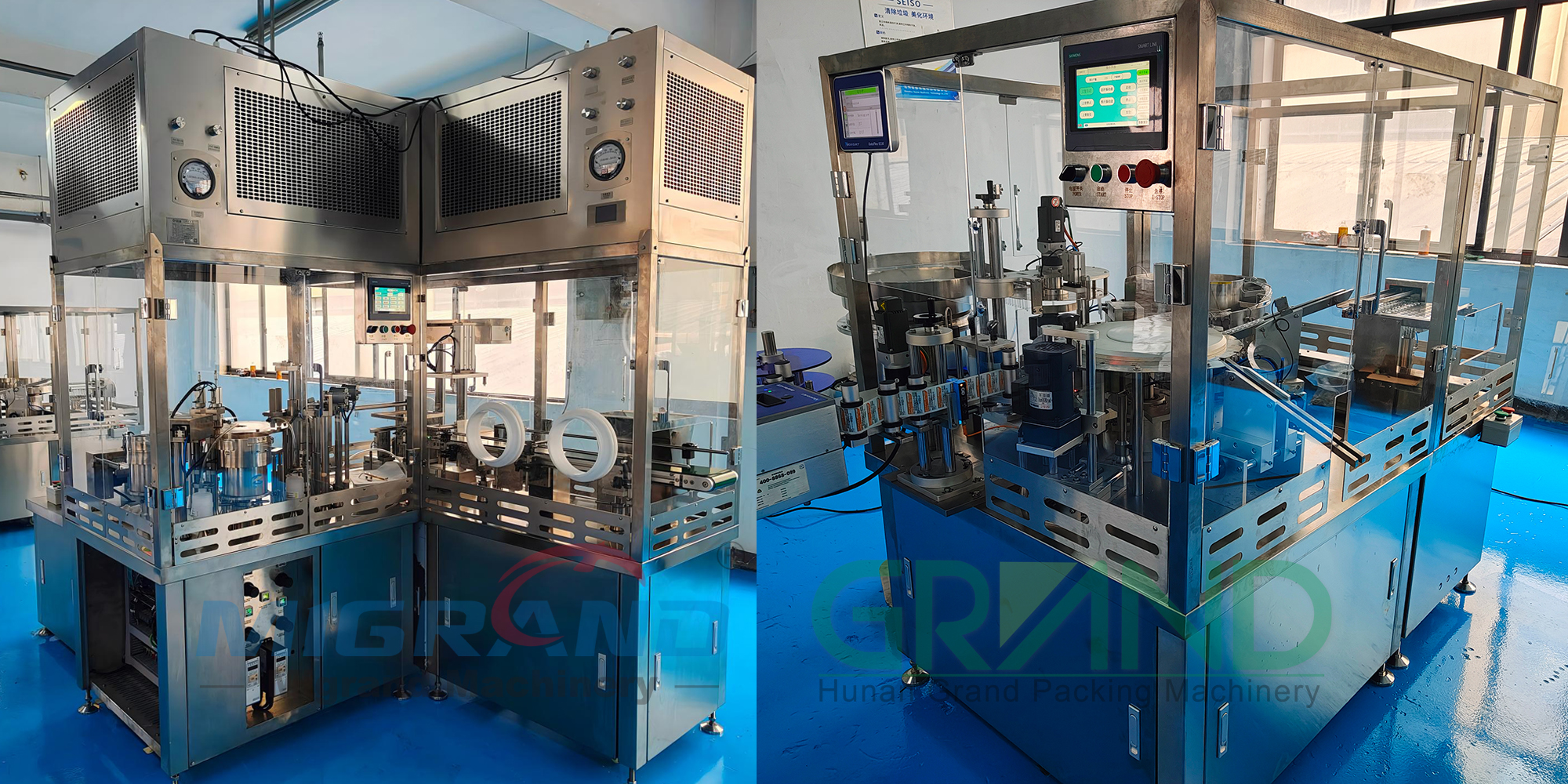
A twin-head filling main unit with automatic tray take-off keeps filling continuous and stable. A tray denester and twin laminar flow hoods, custom-built by a specialist clean-air equipment maker, hold the aseptic condition through filling. As requested, the machine carries 316 stainless steel honeycomb plates, 50 each for 3 ml and 5 ml. Three change-part sets cover 1 ml, 3 ml and 5 ml.
(2) Labeling section
The plunger rod insertion and labeling machine integrates automatic syringe feeding, plunger assembly and a vibratory bowl for rod infeed, with a coding station reserved. Filled syringes move straight into this station and leave with the rod fitted and the label applied, without being unloaded or mixed between batches.
(3) Packaging section
The blister packaging machine is a DPP-180 with two syringe blister moulds, for 3 ml and 5 ml. Both moulds use two-step forming: a pre-draw followed by the final form. For long syringes and deep blisters this gives a more even wall thickness and a fuller form, which reduces film breakage and appearance defects. A third forming mould is supplied for later changeovers and as a spare. Film indexing is servo-driven, so forming and sealing keep their step accuracy. Product loading is manual, with a loading tray, which keeps the machine simple to run and flexible for multi-product, small-batch work. The machine has safety guarding, and the PLC and touchscreen are Siemens, with the HMI written by Migrand.
(4) Interfaces between the three sections
Format: filling and packaging moulds match one to one across 1 ml, 3 ml and 5 ml, and mould numbers and parameter sheets are kept in one table, so a changeover does not need the correspondence worked out again.
Speed: filling and labeling run as a continuous flow, while the packaging section takes product from a loading tray by hand. A short stop upstream does not reach downstream immediately, which makes the whole line easier to settle.
Parameters: recipes, touchscreen parameters and forming and sealing settings are recorded for each mould and handed over with the machine. Packaging mould installation and settings are recorded the same way, so the customer works to one set of records rather than two.
4. Delivery and Support
(1) Staged delivery and lead times
The filling and labeling set was ordered in July 2026 on a 66-day lead time and delivered on 30 September 2026. The blister packaging machine was ordered in August 2026 on a 30-day lead time and delivered on 20 September 2026. The two shipments went out separately, with packaging arriving first, so the customer could install and train on that section before the line was tied together.
When the 1 ml mould was added during production, we handled it the way we handle any change request: say first what it does to the schedule, then absorb it in planning. Where the original date could be held by rescheduling and extra hours, we held it. Where a slip was unavoidable, the customer heard about it before it happened, not at the shipping date.
(2) Changeover and parameter restoration
Each of the three filling sets has its own commissioning recipe and touchscreen parameters, and all of them were kept at delivery. If parameters are changed in daily use, the records restore the original settings. If the PLC data is wiped and cannot be restored directly, the customer works through the saved screen images and corrects the values one by one. Each mould also has a changeover and installation video, so a format change follows the video and is completed quickly and correctly. Packaging moulds keep their forming and sealing settings and installation records in the same form.
(3) Documentation and acceptance records
Before dispatch we recorded a full running video, the HMI screens, and each station and the electrical cabinet. At shipping we recorded the nameplate, stretch wrapping, wooden case, fumigation mark, shipping marks and the sealed container. The machine ships with the operating manual, CE documentation and a mould list. Records match the hardware item by item, so acceptance, routine checks and later traceability all have something to refer to.
5. Closing
This project was not a single-machine order. It joined filling, labeling and packaging into one switchable line: formats held at 1 ml, 3 ml and 5 ml, moulds and parameters recorded as a set, added formats handled as routine work, and delivery run on two orders at different times. What Migrand Machinery does here is what it does elsewhere — turn the customer process requirements into structures, parameters and documents that can be executed, and hand them over on time.
FAQ :
How does a prefilled syringe filling line work?
What is the difference between nested and bulk syringe filling?
What does a plunger rod insertion and labeling machine do?
Why use two-step forming for syringe blisters?
What records should come with a PFS line?

 English