Two One-Hour Calls: Commissioning a Three-Format Filling Line in Bulgaria
Customer feedback · Syrup, nasal spray and throat spray filling and cartoning line · Installation and commissioning support
A filling and cartoning line for syrup, nasal spray and throat spray - ordered in 2025 and shipped in early 2026 - has been installed and commissioned at the customer's plant in Bulgaria. The customer's team assembled the equipment from our drawings and connected the line point by point using the interfaces we had pre-marked. When their engineers ran into difficulties during linked commissioning, our engineers supported them remotely in two sessions of about one hour each. The line has since run stable and gone into production.
The feedback was direct: reliable equipment, simple and easy-to-understand operation, and remote support that was timely, efficient and professional.
One line, three bottle formats
The line runs three products: a 125 mL syrup bottle (110 mm body height, 48 mm diameter, 30 mm cap with a 35 mm measuring cup), and two 50 mL spray bottles (73 mm body height, 36 mm diameter, 15 mm neck) for nasal and throat spray respectively.
Syrup closes with a measuring cup pressed onto the cap; sprays close with a pump or actuator. The two closure logics are entirely different, and one filling and capping machine has to carry two mould sets and two cap-feeding systems - with filling volume, capping action and reject thresholds switching over together at each changeover. That is where the real difficulty of this line sits, and where most commissioning time goes.
All dimensions and configurations were fixed item by item in the technical file signed in September 2025, and production started only after the customer had checked the samples against it.
The line consists of six stages, from empty-bottle unscrambling to finished-carton collection:
Table 1 Line configuration
Stage | Equipment | Key configuration |
Unscrambling | Bottle unscrambler | One mould set each for the syrup bottle and the spray bottle, final dimensions confirmed against customer samples |
Filling / capping | ZHG-50 filling and capping machine | Air-rinsing station for PET bottles; star wheel, cap feeder, cap screwing, measuring-cup feeder and press; heated and stirred hopper, both switchable; stainless steel plunger pump; Videojet 1280 printing date and batch on the syrup cap top |
Checkweighing | Check weigher | Accuracy ±0.1 g depending on product; out-of-range bottles rejected automatically |
Labelling | GDL-A labeller | Videojet 1280 printing date and batch on the label |
Cartoning | GDC-130 cartoner | Leaflet folding, tuck-in sealing, coding on the carton face; conveyor linked directly to the filling line; end platform for collecting finished cartons |
Cleaning | CIP system | 50 L hot-water tank, pure hot water, mobile, working with the line |
Note: the line is operated through Siemens touch screens, with Ethernet Modbus TCP communication between machines.
Installation: getting the interfaces right first
On a liquid-dose line, installation problems rarely sit inside a single machine. They sit at the seams: bottle transfer from the filler to the cartoner, the timing of checkweighing and rejection, the print trigger signal, and the electrical interfaces between sections. One wrong connection there costs several times as much time during commissioning.
Two things were done before shipment. First, the drawings were laid out to the customer's actual workshop, with machine positions, conveyor routing and electrical interfaces marked on them. Second, every interface point was numbered and tagged in advance, so the customer could match each connection to its number on site.
The customer's team assembled and connected the line accordingly; mechanical and electrical connections were in place already at the assembly stage. By the time commissioning started, "which cable goes where" was no longer a question.
The cartoner conveyor is linked directly to the filling line conveyor as specified, and finished cartons are collected on an end platform - no manual transfer from empty bottle to finished carton.
Commissioning: two calls, one hour each
Once each machine ran in manual mode, the real test began: changeover between three bottle formats, matching plunger stroke to filling volume, checkweigh thresholds and reject action, label and code synchronisation, and the cycle match between the cartoner and the upstream conveyor. This is where the customer's engineers hit difficulties.
Our engineers did not fly out. The line runs on Siemens touch screens with Ethernet Modbus TCP, so operating parameters and I/O status can be read remotely - whether the issue sits in a parameter, a sequence or a signal is visible on screen.
Two remote sessions of about one hour each. The first located and corrected the linked logic and parameter settings; the second re-checked changeover and continuous running. After that, the line ran stable and the customer scheduled production.
From "we have a problem" to "bottles running stable", the gap was two hours.
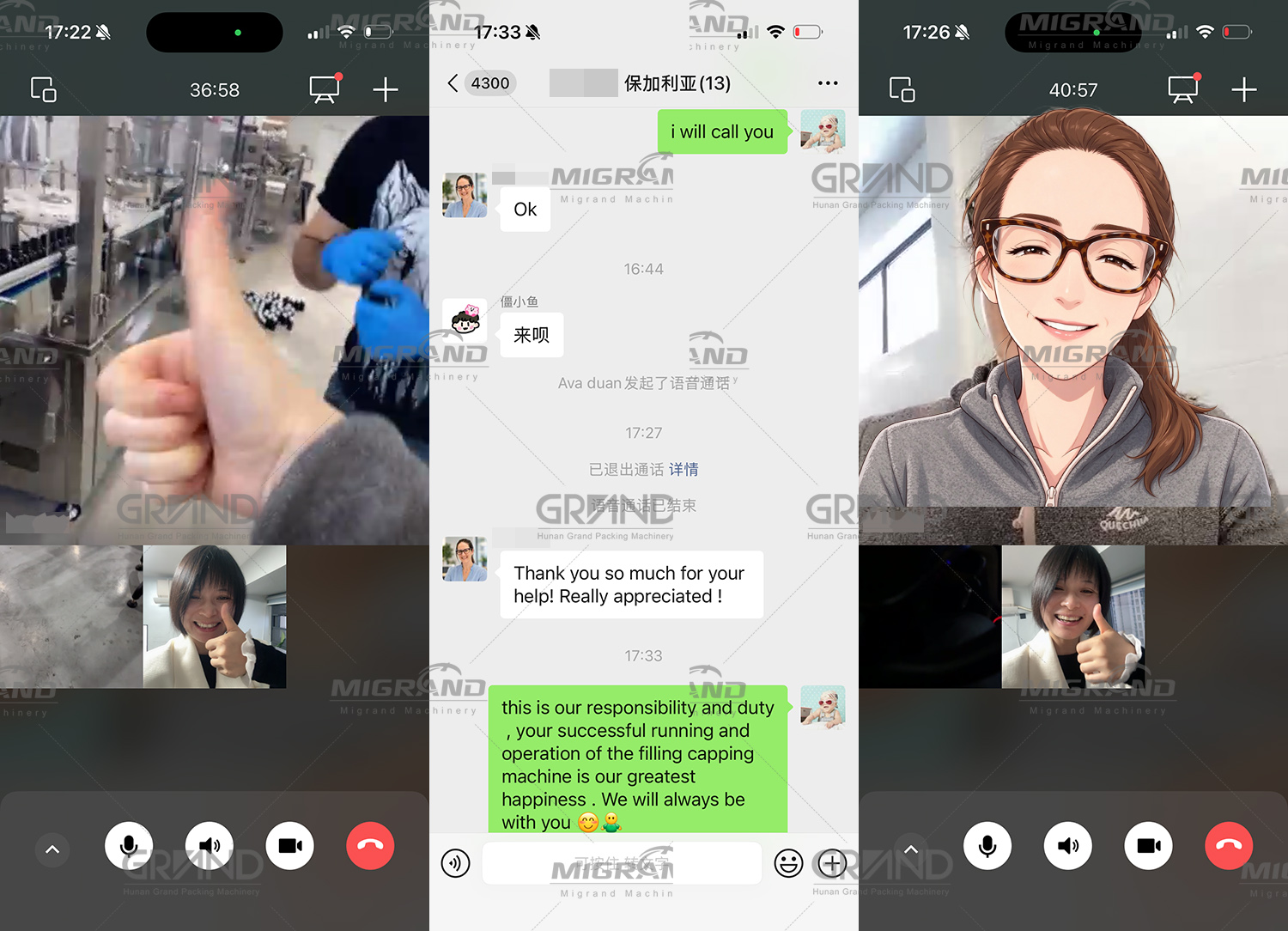
What the customer said
Three points came back in the follow-up.
Equipment quality. The line runs stable in continuous operation, and filling, checkweighing, labelling and cartoning hand over cleanly to one another, without repeated adjustment after a format changeover.
Operation. The Siemens touch-screen interface matches the actual operating steps, the changeover path is clear, and the customer's engineers could operate the line independently with remote guidance - no extra language explanation or long hands-on experience required.
Service. A session was arranged quickly after the problem was reported, the guidance was specific, two sessions closed the issue, and nothing was pushed back onto the customer.
The customer put it as "simple and easy to understand". For a line that runs three bottle formats and two closure logics, that carries more weight than any specification - complexity in the machine is expected; complexity in the operation is not.
Why two hours was enough
It was not luck. Three things had been settled before the line left the factory.
First, the interfaces were fixed at the drawing stage - drawings laid out to the customer's workshop, interface points numbered and tagged, so half of the commissioning was done during assembly.
Second, the control system was built to be diagnosed remotely. Siemens touch screens with Ethernet Modbus TCP mean parameters can be read and status checked; with a closed control box, even the fastest service would have to wait for an engineer to board a plane.
Third, support is structured one layer at a time: linked logic and parameters first, then changeover and continuous running, each session working through a defined checklist instead of leaving problems for the next call.
Closing
The best judge of a line is the customer's workshop. This one went from assembly to production with the customer's own team and two hours of our engineers' time.
We would rather treat that as the standard: drawings that are complete, interfaces that are marked, a control system that can be reached remotely, and support that works through problems layer by layer. What the customer buys is not only a line, but a line that can run on its own.
If you are planning a filling and cartoning line for syrup, oral liquids or sprays, talk to us. We can start with a layout and configuration proposal based on your bottle and carton dimensions.

 English